
Why Your Chatbot Is Failing (And It's Not the AI's Fault)
Most AI chatbot failures have nothing to do with the technology. It has more to do with a design problem, an integration problem, and/or a governance problem dressed up as an AI problem.

👋 Just joining us? Last week, we mapped out the differences between Chatbots, AI Copilots, and AI Agents and why deploying the wrong one has real consequences. This week, we put chatbots under the microscope.
Here’s something nobody in the room ever wants to admit when an AI chatbot project goes sideways.
Come closer. I’ll whisper.
🤫 ...the AI wasn’t the problem.
The technology works, and the models are capable. What actually breaks is everything around the AI, the design decisions, system integrations, knowledge management, guardrails or, more accurately, the absence of all of the above.
We have spent years blaming the bot when the real culprits were sitting in the planning meeting the whole time.
This week, let’s walk through the four failure patterns I see most often in CX chatbot deployments, with real examples, honest explanations of why they happen, and what good actually looks like.

The Hard Truth First
Before we get into the failure modes, let’s establish one thing clearly: a chatbot is only as good as the decisions made before it goes live.
A poorly designed chatbot doesn’t just fail to help, it actively drives customers away. It destroys the trust that your customers have in your business or brand. And because it operates at scale, it can damage thousands of customer relationships simultaneously before anyone notices the pattern.
A well-optimised chatbot, on the other hand, is one of the most powerful tools in a CX team’s arsenal. The difference between the two is rarely the AI model. It’s almost always the execution.
“The chatbot isn’t broken. The thinking behind it is.”
With that said, let’s get into it. Four failure modes, four honest dissections.
Failure Mode 01 🔁 The Endless Loop
⚠ High impact
Picture this. A customer contacts your chatbot with a billing dispute. The bot doesn’t recognise the specific issue, so it serves a generic response. The customer rephrases. Same response. They try again with different words, same response. By the fourth attempt, they’re furious, and they still haven’t spoken to a human.
This is the escalation problem. Most chatbots are built with enormous focus on what happens when things go right, and almost no focus on what happens when things go wrong. The result is a bot that keeps looping canned responses instead of recognising that the conversation has hit a wall.
The fix isn’t complicated, it’s just rarely prioritised. Escalation should be treated as a first-class feature, not an afterthought. Customers should never have to fight for access to a human. The bot should be doing that work for them, automatically, when the signals are clear.
✦ Here's what to do instead
Implement sentiment analysis to detect rising frustration and trigger escalation automatically
Escalate after two or three failed resolution attempts, don’t wait for the customer to ask
When a customer explicitly requests a human, that request should be honoured immediately, every time
Warm handoffs pass the full conversation context to the agent so the customer never has to repeat themselves
Failure Mode 02 🏝️ The Island Bot
⚠ Medium — High impact
I’ll sound like a broken record here, and honestly, I’m fine with that. This point plays on a loop in my head because I keep watching teams make the same mistake and then act surprised by the results.
A chatbot operating in isolation is a chatbot that can only ever be generic. You have customer data sitting in your CRM. Order history in your management system. Account details in your billing platform. And your chatbot has no idea any of it exists.
So when a customer asks, “Where is my order?” the bot serves a generic tracking page link. When they ask about their account status, it draws a blank. It knows nothing about the person it’s talking to, not their history, not their tier, not their last interaction. Every conversation starts from zero.
Generic in, generic out. On repeat. Every single time.
Teams launch chatbots as standalone tools, disconnected from the systems that hold all the context, and then wonder why the responses feel hollow.
The gap isn’t the AI. It’s the architecture around it.
✦ Here's what to do instead
The fix is straightforward even if the implementation isn't, connect your chatbot to your data systems. Your CRM, order management, billing platform, and knowledge base should all be feeding context into every conversation. A bot with access to the full picture will always outperform one working in the dark.
Failure Mode 03 📚 The Stale Knowledge Problem
⚠ Medium impact
A chatbot is only as accurate as what it’s been taught. Feed it an incomplete knowledge base, and it fills the gaps with guesswork. Feed it an outdated one, and it confidently serves customers information that is no longer true. Both are damaging. The second one is often more so, because the customer has no reason to doubt a confident, well-worded wrong answer.
This failure is especially common in organisations that treat the knowledge base as a launch asset rather than a living document. Products change. Policies evolve. Pricing updates. The chatbot doesn’t know this unless someone tells it.
The result? Fragmented, unreliable responses. And customers who stop trusting the bot entirely after one bad experience.
✦ Here’s what to do instead
Treat the knowledge base as a live product, assign ownership and a regular review cadence
Run the bot against real customer scenarios regularly to catch gaps before customers do
Mine failed or low-confidence interactions to identify what the knowledge base is missing
Failure Mode 04 — The Big One
🎭 Hallucination & The Governance Gap
🔴 Critical
This is the one that keeps CX leaders up at night, and rightly so. AI hallucination is when a model generates a response that sounds completely confident and coherent, but is factually wrong. The AI doesn’t know it’s wrong. It just sounds right.
Research puts hallucination rates somewhere between under 5% for straightforward questions and over 25% in complex, multi-step scenarios. Even retrieval-augmented systems (RAG), the ones designed to ground the AI in real documents, can fail if they pull stale as we discussed earlier or irrelevant content.
In customer service context, this isn’t just embarrassing. It’s legally and financially dangerous. Regulators in multiple markets are now treating AI-generated misinformation as a potential deceptive business practice. If your chatbot misleads a customer, even unintentionally, your company can be held responsible.
The uncomfortable truth about hallucination is that there is no perfect solution. But there is a meaningful difference between organisations that have thought seriously about this risk and those that haven't.
✦ Here’s what to do instead
Deploy an assurance layer i.e a system that provides visibility into who the bot is talking to, why, and when
Build detection for when answers deviate from approved, verified sources
Establish clear compliance boundaries i.e what the bot is and is not permitted to discuss
Log and review low-confidence responses regularly, not just customer complaints
Treat prompt injection as a real attack vector and test for it before launch
Before You Launch — A Quick Honest Check
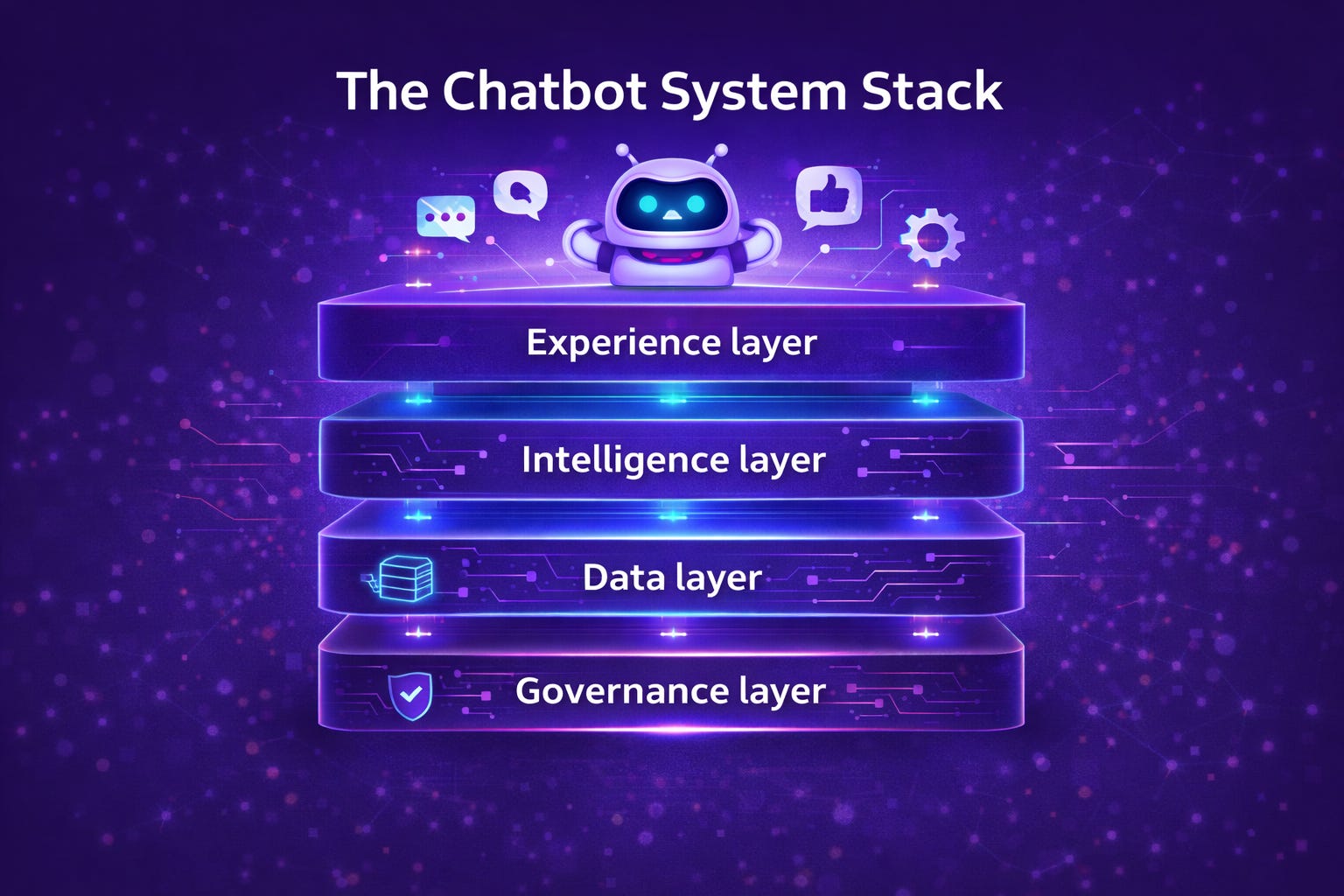
If you are about to deploy a chatbot, or if you have one live and are wondering why it’s underperforming, run it against this list. Not as a formality but as a genuine diagnostic.
The deployment health check
🔁Does your bot have a clear, automatic escalation path, or does it loop?
🔗Is it connected to your data systems?
📅When was the knowledge base last reviewed and updated?
👤Does the bot personalise responses using customer history and context?
🛡️Do you have a governance layer monitoring for hallucinations and prompt injection?
📊Are you reviewing failed interactions regularly, not just overall satisfaction scores?
If any of those feel shaky, that’s where to focus. Not on the AI model. Not on the interface design. The fundamentals above will move the needle far more than switching to a newer model ever will.
Chatbots are not failing because AI is overhyped. They’re failing because we keep treating the fundamental problem as a technology problem when it’s actually a service design problem.
The best chatbot aren’t the most technically sophisticated. But the most thoughtfully built, with real escalation paths, real integrations, a live knowledge base, and a team that actually reviewed what went wrong regularly.
That’s it. That’s the secret.
That’s my view for the week. See you next week 😉